Application Discovery · Dependency Mapping · Legacy Modernization
Stop Staffing Tickets. Start Preventing Them.
Most L1/L2 effort goes into triage, not resolution. QyrusAI reads every ticket, log, and signal in context, diagnoses root cause in minutes, and resolves routine incidents autonomously — turning your support layer from a cost center into a funding source for modernization.
How it works
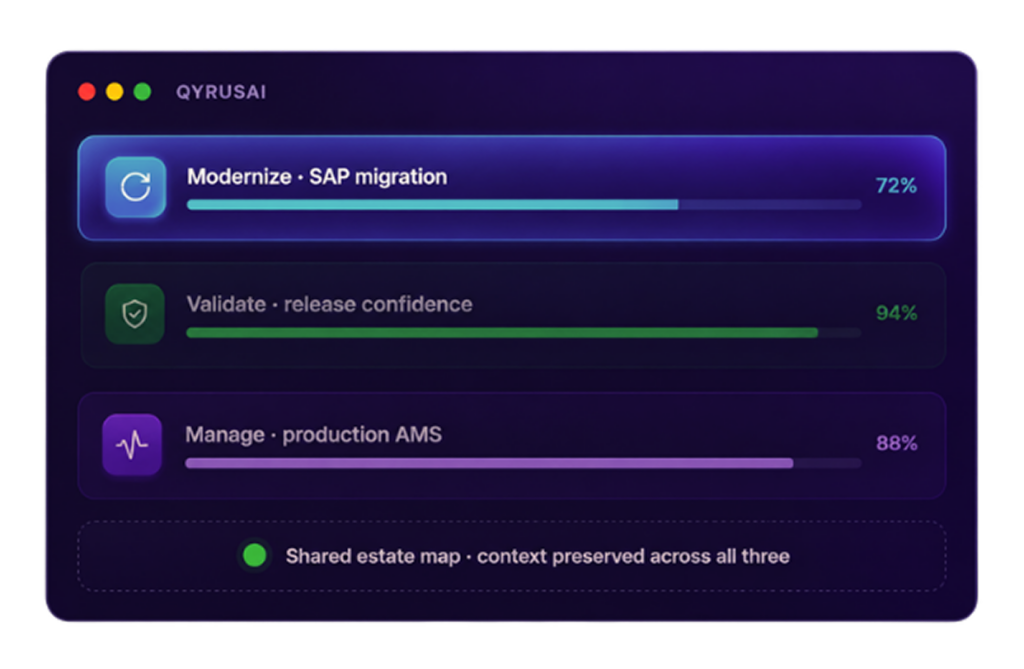
Challenges
The L1/L2 Problem
Every Enterprise Knows.
Support tiers are drowning in volume they shouldn’t have to touch. Discover how replacing manual triage and SME-dependent diagnosis with a knowledge-graph-driven agentic layer turns L1/L2 from a headcount problem into a self-resolving system.

Triage Without Context
Tickets are routed on keywords and gut feel, not on how the underlying applications and infrastructure actually connect – so the wrong team ends up owning the wrong problem.
Explore
The Same Tickets, Over and Over
Without a system that learns from resolutions, L1/L2 keeps re-solving the same class of incident — ticket volume never actually shrinks.
Explore

Diagnosis That Depends on People
Root cause analysis relies on fragmented historical tickets and SME memory, consuming 1 to 10 hours per incident before a fix is even attempted.
Explore
Escalation as the Default
When L1 can’t resolve it, it moves to L2, then L3 — not because the issue is complex, but because no one has the context to stop the handoff.
Explore
Download PoV
How it works
Discover the Estate. Detect the Signal.
Diagnose the Cause. Remediate Autonomously.
Explore how QyrusAI compresses the ticket lifecycle — from first alert to validated fix — using a live Knowledge Graph and agentic AI workflows that operate with intent, not just instructions.
Discover
Detect
Diagnose
Remediate
Continuously map infrastructure, applications, and ticket patterns — automatically.
QyrusAI builds a real-time inventory of VMs, networks, and applications alongside historical ticket trends, clustering repeated incidents and service requests as they emerge. No manual inventory audits — the estate and its failure patterns are observed, not surveyed.
View More
Separate the signal from the noise before an agent ever gets involved.
Anomaly detection, event correlation, and incident prediction filter out non-actionable alerts, so L1 agents only see what actually requires attention. This shifts the team from reactive alert-chasing to proactive, prioritized triage.
View More
Identify root cause in minutes, not hours.
Using the Knowledge Graph, QyrusAI enriches each incident with dependency context and prescriptive solution paths – compressing a 1–10-hour manual RCA process to under 30 minutes and letting L1.5 agents resolve what used to require L2/L3 escalation.
View More
Resolve routine incidents autonomously — with a human in the loop where it matters.
QyrusAI executes self-healing workflows generated and validated through Digital Twin simulation, closing the loop from detection to confirmed resolution — without waiting on a human to execute every step.
View More
Continuously map infrastructure, applications, and ticket patterns — automatically.
QyrusAI builds a real-time inventory of VMs, networks, and applications alongside historical ticket trends, clustering repeated incidents and service requests as they emerge. No manual inventory audits — the estate and its failure patterns are observed, not surveyed.
View More
Continuously map infrastructure, applications, and ticket patterns — automatically.
QyrusAI builds a real-time inventory of VMs, networks, and applications alongside historical ticket trends, clustering repeated incidents and service requests as they emerge. No manual inventory audits — the estate and its failure patterns are observed, not surveyed.
View More
Separate the signal from the noise before an agent ever gets involved.
Anomaly detection, event correlation, and incident prediction filter out non-actionable alerts, so L1 agents only see what actually requires attention. This shifts the team from reactive alert-chasing to proactive, prioritized triage.
View More
Separate the signal from the noise before an agent ever gets involved.
Anomaly detection, event correlation, and incident prediction filter out non-actionable alerts, so L1 agents only see what actually requires attention. This shifts the team from reactive alert-chasing to proactive, prioritized triage.
View More
Identify root cause in minutes, not hours.
Using the Knowledge Graph, QyrusAI enriches each incident with dependency context and prescriptive solution paths – compressing a 1–10-hour manual RCA process to under 30 minutes and letting L1.5 agents resolve what used to require L2/L3 escalation.
View More
Identify root cause in minutes, not hours.
Using the Knowledge Graph, QyrusAI enriches each incident with dependency context and prescriptive solution paths – compressing a 1–10-hour manual RCA process to under 30 minutes and letting L1.5 agents resolve what used to require L2/L3 escalation.
View More
Resolve routine incidents autonomously — with a human in the loop where it matters.
QyrusAI executes self-healing workflows generated and validated through Digital Twin simulation, closing the loop from detection to confirmed resolution — without waiting on a human to execute every step.
View More
Resolve routine incidents autonomously — with a human in the loop where it matters.
QyrusAI executes self-healing workflows generated and validated through Digital Twin simulation, closing the loop from detection to confirmed resolution — without waiting on a human to execute every step.
View More
Core Features
Built to Turn Support Tiers Into
a Self-Resolving System.
Stop measuring L1/L2 by headcount and ticket backlog. Discover how a live Knowledge Graph, agentic remediation, and continuous learning turn routine support into an autonomous, self-improving layer.
Intelligent Ticket Triage
Automatically detects assignment group, priority, and intent for every incoming ticket – eliminating the manual “triage hop” and routing loss.
Knowledge-Graph RCA
Enriches every incident with dependency context, compressing root cause analysis from hours to minutes and reducing SME dependency.
Agentic Auto-Remediation
Executes governed, human-in-the-loop AI workflows to resolve L1/L1.5 incidents autonomously, validated against Digital Twin simulations.
Continuous Learning Loop
Feedback mechanisms like the KB Nudger and Incident Summarizer refine agent knowledge with every resolution — shifting the mission from ticket resolution to ticket prevention.
A GLIMPSE ON THE NUMBERS
Outcomes & Benefits
Rationalize Faster. Reduce Risk. Fund the Transformation.
Secure a resilient, future-proofed IT ecosystem capable of adapting instantly. Achieve rigorous performance benchmarks while drastically lowering operational overhead.
60
%
cost reduction in L1/L2 activities
80
%
Improvement in MTTR
40-
41
%
reduction in routine operations effort
15-
16
%
improvement in CSAT scores
Continuous testing. Continuous learning. Continuous value.

Join leading enterprises
driving the loop forward.

Integration
Works With Your
Existing Enterprise Stack.
QyrusAI Modernize connects to your existing tools — CMDBs, ITSM platforms, cloud providers, and enterprise architecture repositories — so discovery enriches the tools you already use rather than replacing them.






CUSTOMER TESTIMONIALS
Enterprises running the loop
in their own words.
Real Teams. Real Outcomes. Real Confidence in what ships next.
Lorem Ipsum Dolor Sit Amet. Lorem Ipsum Dolor Sit Amet. Lorem
Qyrus not only supports the testing of our Web, Mobile, and API components as part of our CI/CD processes, but also in ongoing regression-testing across our partner ecosystem. The real power of Qyrus is that we have this extremely broad testing capability in one tool, run in the cloud, and reusable across all our development teams.
Shawbrook Bank
The transition to Qyrus has marked a significant turning point for us. By embracing automation, we not only streamlined our SAP test automation process but also achieved a remarkable reduction in overall project testing time by 40%.
Subaru

… the Qyrus platform have been a great addition to Monument’s product delivery capabilities. Within a few months, we have been able to create a comprehensive test suite of complex end-to-end test scenarios spanning multiple platforms and channels. The Quinnox team has helped us embed the Qyrus solution, and the supporting processes around it, into our agile delivery methodology.
Monument
Resources
Go Deeper on QyrusAI L1/L2 Automation
Dive into our latest research and implementation guides. See how a live Knowledge Graph paired with agentic remediation turns support-tier automation into a funding mechanism for broader modernization.
Blog
 August 19, 2026 |
  18 min
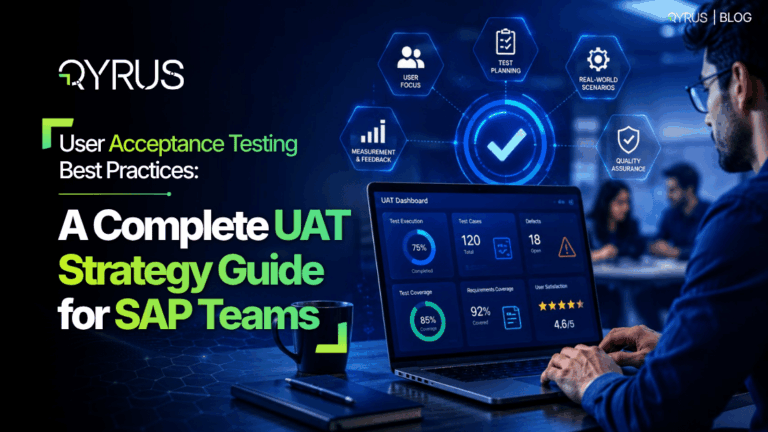
User Acceptance Testing Best Practices: A Complete UAT Strategy Guide for SAP Teams

August 6, 2026 | 14 min
SAP UAT Test Cases: Templates, Examples & Design Best Practices

July 27, 2026 | 10 min
SAP IBP Testing: A Practical Guide for QA and Planning Teams
Read More
Load More 

Case Study
September 17, 2025 | 5 min
From Bottlenecks to Breakthroughs: A Coca-Cola Bottler’s Quality Transformation
Read More
Food and Beverages
June 27, 2025 | 5 min
AI-Powered Testing Transforms One of the Largest Beverage Companies
Read More
BFSI
June 20, 2025 | 8 min
150% Efficiency Boost for Banking Client Using Device Farm
July 13, 2026 | 1 min
Meet Qyrus at the BFSI Innovation & Technology Summit India 2026

April 6, 2026 | 3 min
Qyrus at QonfX Bangalore: AI Testing, Context Engineering & QA Innovation

March 23, 2026 | 3 min
STAREAST 2026: Joining the Quality Engineering Conversation in Orlando
August 13, 2026 | 2 min
Qyrus Named in Gartner’s Market Overview for API and MCP Testing Tools
August 12, 2026 | 2 min
Modernize SAP Before 2027 Without Letting Defects Reach Go-Live
June 29, 2026 | 3 min
Why UK Fintechs Are Making QA Central to Operational Resilience.
August 13, 2026 | 2 min
Qyrus Named in Gartner’s Market Overview for API and MCP Testing Tools
August 12, 2026 | 2 min
Modernize SAP Before 2027 Without Letting Defects Reach Go-Live
June 29, 2026 | 3 min
Why UK Fintechs Are Making QA Central to Operational Resilience.
Blog
August 19, 2026 | 18 min
User Acceptance Testing Best Practices: A Complete UAT Strategy Guide for SAP Teams
August 6, 2026 | 14 min
SAP UAT Test Cases: Templates, Examples & Design Best Practices
July 27, 2026 | 10 min
SAP IBP Testing: A Practical Guide for QA and Planning Teams
Case Study
Case Study
September 17, 2025 | 5 min
From Bottlenecks to Breakthroughs: A Coca-Cola Bottler’s Quality Transformation
Read More
Food and Beverages
June 27, 2025 | 5 min
AI-Powered Testing Transforms One of the Largest Beverage Companies
Read More
BFSI
June 20, 2025 | 8 min
150% Efficiency Boost for Banking Client Using Device Farm
Events

July 13, 2026 | 1 min
Meet Qyrus at the BFSI Innovation & Technology Summit India 2026
April 6, 2026 | 3 min
Qyrus at QonfX Bangalore: AI Testing, Context Engineering & QA Innovation
March 23, 2026 | 3 min
STAREAST 2026: Joining the Quality Engineering Conversation in Orlando
Reports
August 13, 2026 | 2 min
Qyrus Named in Gartner’s Market Overview for API and MCP Testing Tools
August 12, 2026 | 2 min
Modernize SAP Before 2027 Without Letting Defects Reach Go-Live
June 29, 2026 | 3 min
Why UK Fintechs Are Making QA Central to Operational Resilience.
Whitepaper
August 13, 2026 | 2 min
Qyrus Named in Gartner’s Market Overview for API and MCP Testing Tools
August 12, 2026 | 2 min
Modernize SAP Before 2027 Without Letting Defects Reach Go-Live
June 29, 2026 | 3 min
Why UK Fintechs Are Making QA Central to Operational Resilience.
FREQUENTLY ASKED QUESTIONS
Common Questions About QyrusAI Modernization
Lorem ipsum dolor sit amet, consectetur adipiscing elit, sed do eiusmod tempor
incididunt ut labore et dolore magna aliqua. Ut enim ad minim veniam, quis nostrud.
How is this different from a CMDB or an EA repository like LeanIX?
A CMDB is maintained by FTEs and is outdated within days of any infrastructure change. LeanIX and similar repositories are populated by surveys — they capture what people say is true, not what the system is actually doing. QyrusAI discovers your estate by observing it in real time: reading APIs, data flows, system calls, and infrastructure events. The graph stays current because it is updated continuously, not because someone remembers to update a ticket. The moment your CMDB says a dependency does not exist, QyrusAI’s observed graph is the source of truth.
Does Qyrus Modernize work with SAP S/4HANA migrations?
Yes — and SAP migrations are one of the highest-urgency use cases. QyrusAI reads your SAP environment in read-only mode, inventories all RFCs, IDocs, OData services, SOAP connections, CPI integrations, background jobs, and Z-objects, and produces a blast-radius score for every proposed S/4HANA change. The Estate X-Ray and Phase Zero governance workflow are specifically designed for ECC-to-S/4HANA programmes with fixed cutover dates.
How long does the initial discovery scan take?
The first scan of a mid-market estate (200–400 applications) typically produces an initial topology map within 48–72 hours. The map enriches continuously from that point — adding confidence detail, business-service attribution, and dependency validation as more signals are observed. A Phase Zero engagement (discovery, dependency mapping, and modernization prioritization) is typically scoped at 4–6 weeks.
Does it require agent installation on every system?
No. QyrusAI reads from APIs, connectors, log streams, and cloud provider metadata — it does not require an agent on every application or server. For some legacy on-premise environments a lightweight collector may be deployed, but this is scoped per engagement and never required across the full estate before value is delivered.
What happens to the modernization plan if the estate changes while the programme is running?
The Knowledge Graph is continuously updated. If a new application is deployed, a dependency changes, or a system is decommissioned mid-programme, the change is reflected in the graph and the modernization wave plan is re-scored automatically. Your transformation plan is always based on the current estate, not the estate as it was when the programme started.
Does Qyrus Modernize integrate with Assure for testing?
Yes — this is the core joint value of the two pillars. Every modernization slice Modernize produces is automatically handed to Assure for equivalence testing. Assure generates test cases from the code analysis output, runs them against the modernized slice, and produces an evidence record before any release decision is made. The conversion is never marked complete until Assure has proved it works.
A CMDB is maintained by FTEs and is outdated within days of any infrastructure change. LeanIX and similar repositories are populated by surveys — they capture what people say is true, not what the system is actually doing. QyrusAI discovers your estate by observing it in real time: reading APIs, data flows, system calls, and infrastructure events. The graph stays current because it is updated continuously, not because someone remembers to update a ticket. The moment your CMDB says a dependency does not exist, QyrusAI’s observed graph is the source of truth.
Yes — and SAP migrations are one of the highest-urgency use cases. QyrusAI reads your SAP environment in read-only mode, inventories all RFCs, IDocs, OData services, SOAP connections, CPI integrations, background jobs, and Z-objects, and produces a blast-radius score for every proposed S/4HANA change. The Estate X-Ray and Phase Zero governance workflow are specifically designed for ECC-to-S/4HANA programmes with fixed cutover dates.
The first scan of a mid-market estate (200–400 applications) typically produces an initial topology map within 48–72 hours. The map enriches continuously from that point — adding confidence detail, business-service attribution, and dependency validation as more signals are observed. A Phase Zero engagement (discovery, dependency mapping, and modernization prioritization) is typically scoped at 4–6 weeks.
No. QyrusAI reads from APIs, connectors, log streams, and cloud provider metadata — it does not require an agent on every application or server. For some legacy on-premise environments a lightweight collector may be deployed, but this is scoped per engagement and never required across the full estate before value is delivered.
The Knowledge Graph is continuously updated. If a new application is deployed, a dependency changes, or a system is decommissioned mid-programme, the change is reflected in the graph and the modernization wave plan is re-scored automatically. Your transformation plan is always based on the current estate, not the estate as it was when the programme started.
Yes — this is the core joint value of the two pillars. Every modernization slice Modernize produces is automatically handed to Assure for equivalence testing. Assure generates test cases from the code analysis output, runs them against the modernized slice, and produces an evidence record before any release decision is made. The conversion is never marked complete until Assure has proved it works.
Move From Ticket Resolution to
Ticket Prevention.
30-minute walkthrough with a solutions architect — we’ll show you where your L1/L2 volume is coming from, and how QyrusAI would resolve it autonomously today.
Talk to an expert